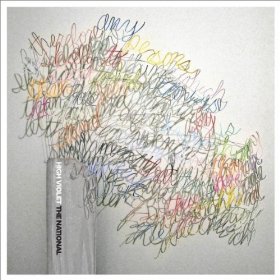
 In my write up for my pick of 2007’s album of the year, I remarked that “no album grabs you by the heart and hits you in the gut like The National’s Boxer.” Three years later, I may have to re-phrase that to say no band grabs you by the heart and hits you in the gut as The National, because with High Violet, The National have once again created an album full of haunting anthems that burrow beneath your skin and become implanted in your every thought. No band does somber, yet somehow not depressing, like Brooklyn’s The National. There is a subtle bit of hope in all of their tunes that gives it a sense of majesty that really can’t be matched by any band. It’s an accomplishment that is truly remarkable and probably doesn’t get the credit deserves, but with High Violet, the band’s achievements are becoming harder and harder to ignore.
Much like Boxer, The National use High Violet to tackle such themes of urban alienation and other concerns of the middle class as those day to day tasks become mundane and fears of a life wasted start to creep into one’s mind. However, whereas Boxer‘s subject matter tended towards uncertainty during a transition period, High Violet is more concerned about the after effects of the transition and trying to find the vibrant colors in what may seem like a dull colorless existence (I mean, just look at the cover art.)
Musically, High Violet isn’t breaking any new ground for the group, but it does refine and improve on all the band’s strengths. Matt Berninger still doesn’t encompass enough of a range to be considered a great singer, but his baritone vocals remain a perfect fit for the moody music that backs him up. Only Berninger could pack a sadness into a string of “doo doo doo”s like he does on “Lemonworld”, and the vulnerability in his voice makes it seem like there’s as much being said in those short fillers than most bands try to say on a complete album. But with any National album, it’s those two set of brothers behind Berninger that take the band to it’s level of immense grandeur. As usual, this starts with the rhythm section and drummer Bryan Devendorf. While poor or uninspired drumming doesn’t necessarily kill a song, used effectively it can absolutely take it to new levels and The National have perfected that with Devendorf’s driving percussion. Other than Bernigner’s voice, there is probably not a more distinctive part of The National’s sound than it’s drumming, and it’s done in such a subtle way that it doesn’t overbear the rest of the music one bit. It’s truly mesmerizing how well these five guys work as a quintet.
The album’s most triumphant moments comes from the Sufjan Stevens assisted “Afraid of Anyone” and first single “Bloodbuzz Ohio”, which both rival anything the group has ever done. They’re the most immediate and memorable songs on an album full of intricate compositions that take a little more effort from the listener to appreciate, but don’t sacrifice any of their depth. It’s not all perfect, however, and unfortunately the flaws show up on the bookends of the disc. Opening track “Terrible Love” is a wonderful song and after being debuted on Jimmy Fallon, was thought of to be one of the album highlights, but for some reason the band ravished the song with questionable production. For a band known for its precise songwriting and meticulousness during the production process, there’s no doubt this was done on purpose. But intentional or not, why they decided to take such a promising song and muck it up with muddy production is beyond me. Likewise, while “Vanderlyle Crybaby Geeks” is a fine song, it feels unnecessarily tacked on to the end. The album would have been fine being capped off at 10 tracks and having “England” close it out. But when my biggest quibbles are production techniques and song placement, it’s clear that I’m grasping for straws when trying to find the album’s imperfections.
High Violet is another masterful release from this group of unassuming sorrowful rockers, their third such masterpiece in a row. While Boxer one upped its predecessor Alligator, it’s hard to say if High Violet has done the same to Boxer. But when your predecessor was one of the best albums of the last decade, merely matching up to it is an accomplishment of its own and I have no qualms saying High Violet has done at least that.
[“Bloodbuzz Ohio” – High Violet]


 Posted by Hawkins
 A Round of Sound